
|
|
|
WW1
CUMMINGS, ROY LYTTON
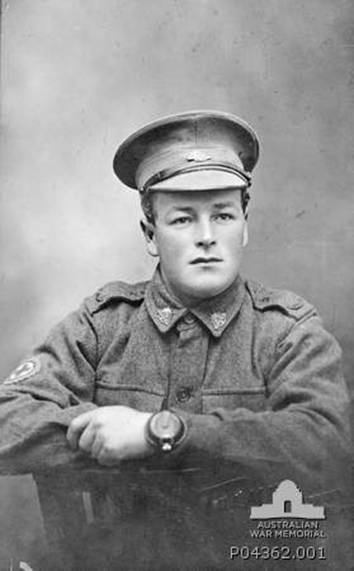 Studio portrait of 5561 Private Roy
Lytton Cummings, 3rd Field Ambulance, 10th
Reinforcements, prior to his departure for service
overseas. A native of Franklin, Tas, Cummings enlisted
on 19 November 1914. He embarked for service overseas
aboard HMAT Ballarat (A70) on 9 September 1915 and saw a
short period of service in the last month of the
Gallipoli campaign. In January 1916, he successfully
applied to be remustered as a Driver and saw service in
France with No 4 Ammunition Sub Park at Rouen until July
1917, when he applied for a transfer to the Flying Corps
and was accepted on 29 September 1917. Assigned to No 5
(Training) Squadron, Australian Flying Corps (based at
Minchinhampton, Gloucestershire), in early 1918,
Cummings quickly displayed an impressive flair for
flying. Major Brown, commanding 5 Squadron AFC, wrote to
Cummings' father 'he came to me as a pupil and did so
well I had him made an instructor'. Second Lieutenant
Cummings passed his instructor's course in May 1918, and
actively trained student pilots at Minchinhampton until
he was killed several months later in a flying accident,
aged 24 years. At 7.25 am on the morning of 28 August
1918, Cummings and his pupil, Lieutenant Scott, were
flying above the aerodrome when a pupil from another
squadron flying by himself (Ernest Jefferys of No 6
(Training) Squadron, AFC, who had been ordered to
practise turns), collided with Cummings' aircraft at a
height of 1,500 feet. Both machines crashed to earth,
killing all three occupants instantly. Following an
inquest into the incident, a verdict of accidental death
was reached in the cases of all three AFC officers Studio portrait of 5561 Private Roy
Lytton Cummings, 3rd Field Ambulance, 10th
Reinforcements, prior to his departure for service
overseas. A native of Franklin, Tas, Cummings enlisted
on 19 November 1914. He embarked for service overseas
aboard HMAT Ballarat (A70) on 9 September 1915 and saw a
short period of service in the last month of the
Gallipoli campaign. In January 1916, he successfully
applied to be remustered as a Driver and saw service in
France with No 4 Ammunition Sub Park at Rouen until July
1917, when he applied for a transfer to the Flying Corps
and was accepted on 29 September 1917. Assigned to No 5
(Training) Squadron, Australian Flying Corps (based at
Minchinhampton, Gloucestershire), in early 1918,
Cummings quickly displayed an impressive flair for
flying. Major Brown, commanding 5 Squadron AFC, wrote to
Cummings' father 'he came to me as a pupil and did so
well I had him made an instructor'. Second Lieutenant
Cummings passed his instructor's course in May 1918, and
actively trained student pilots at Minchinhampton until
he was killed several months later in a flying accident,
aged 24 years. At 7.25 am on the morning of 28 August
1918, Cummings and his pupil, Lieutenant Scott, were
flying above the aerodrome when a pupil from another
squadron flying by himself (Ernest Jefferys of No 6
(Training) Squadron, AFC, who had been ordered to
practise turns), collided with Cummings' aircraft at a
height of 1,500 feet. Both machines crashed to earth,
killing all three occupants instantly. Following an
inquest into the incident, a verdict of accidental death
was reached in the cases of all three AFC officersDr and Mrs H L Cummings of Franklin have just received details of the cause of the accident which resulted in the death of their son, Temporary Captain Roy Cummings of the Australian Flying Corps and a short account of the military funeral It was explained that the deceased officer and a pupil, Lieutenant Scott, were having a fly before breakfast around the aerodrome when a pupil from another squadron, flying by himself, suddenly turned his machine upwards and crashed into them The two machines were about 700 feet up when they collided, and were partially locked together when they fell All three aviators were killed outright. The Officer in charge of the Headquarters Flying Corps describes his death as a sad loss to the flying service as, apart from his great popularity with everyone who knew him, he was one of the most efficient instructors in the "wing ' Major B L Brown, officer in charge of No 5 Flying Squadron, wrote, stating that the deceased officer showed great promise as a pilot, and would, had he been spared, have done fine work in France. Amongst his brother officers he was known as a "white man," which was the greatest compliment that could be paid any man. Cadet Lieutenant H M Cummings, in a pathetic letter to the parents, referring to the death of brother Roy says that the authorities took the very unusual course of promoting the latter to the rank of Captain after his death. He also mentioned that his younger brother, Eric, had recently been appointed to the rank of captain. The latter is on active service in France, and in one day recently brought down two enemy aeroplanes The Mercury 11th November 1918
|
Please note that there might be information from other websites or brochures "reprinted" here- under the laws of "fair use". In every instance -we hope- we have provided a direct link to the owners web site. We do not claim rights or ownership to any of their information. We do thank them sincerely for their efforts. We have in every instance made a good faith effort to contact and request 'reprint' permission. Nonetheless, we do want to be certain that nothing gets lost due to web site disappearance and the like, so it appears duplicated here. Tasmanian War Casualties, Honouring the past, building understanding. Copyright © 2016 Tasmanian War Casualties |
